Engineering
A practical checklist for reviewing costs after a deployment
Connect a release to a focused cost investigation, with aligned periods, business context and a clear record of the next decision.
A release changes the application. Sometimes it changes the bill as well. A useful cost review starts with the release timeline and asks what evidence would distinguish an expected increase from an unintended effect.
Define the review window
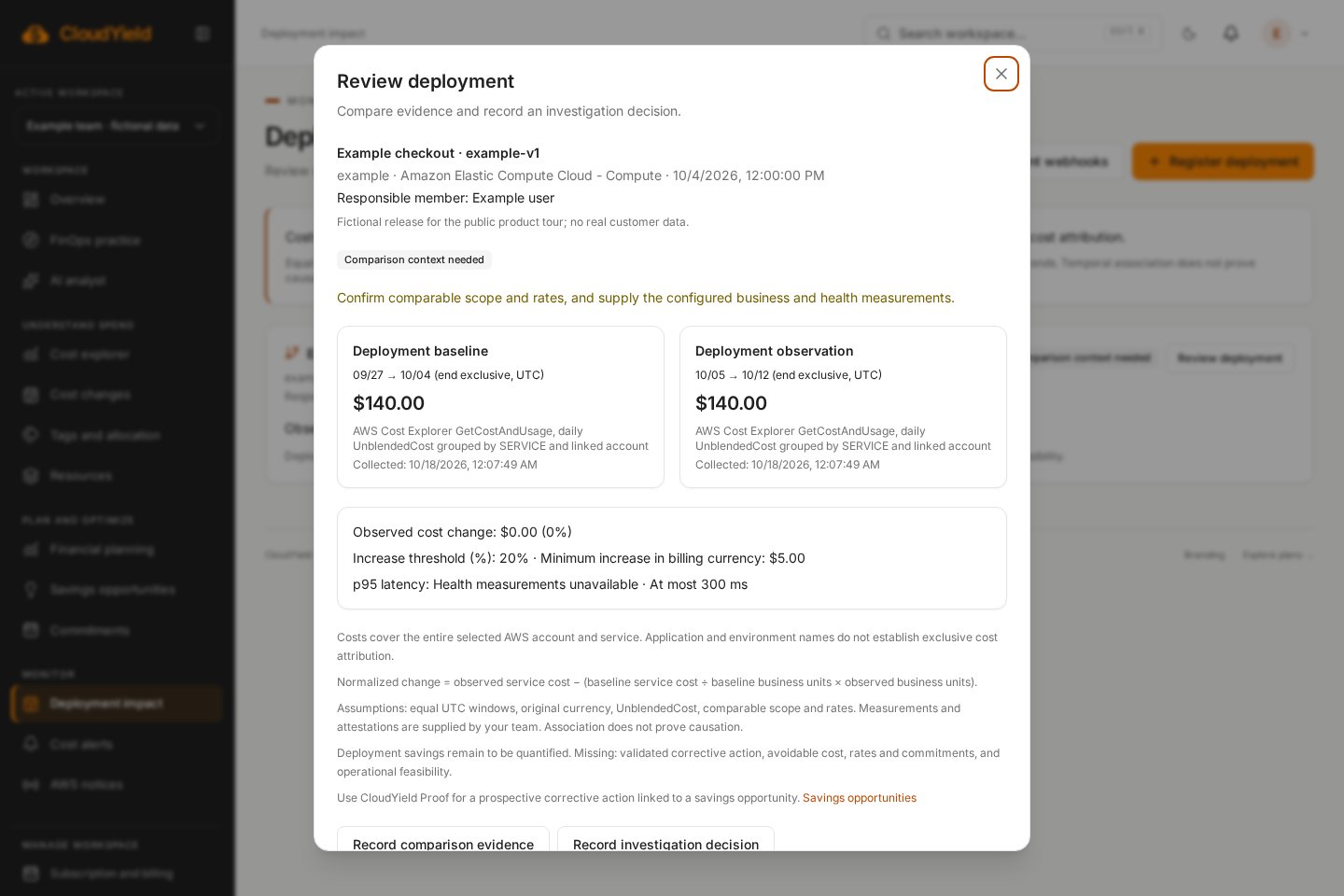
Record the deployment time, affected services and the person responsible for the review. Compare periods of equivalent length and consider the workload schedule. A weekend and a business day can represent very different demand.
Keep incomplete billing periods visible. If one side of the comparison is still accumulating charges, describe that limitation before interpreting the difference.
Compare the same scope
Use the same accounts, services, regions and currencies on both sides. Keep shared charges separate from costs that can be attributed to the changed workload.
A service-level increase is a reason to investigate. It does not prove that one resource or one deployment caused it. Preserve other plausible explanations such as traffic changes or overlapping releases.
Review business and operational context
- What happened to request volume or completed jobs?
- Did error rates, latency or availability change?
- Did the deployment introduce a new dependency?
- Were other changes made during the same window?
- Has the billing evidence reached a comparable level of completeness?
Record the source and period for each answer. When information is missing, keep the conclusion conditional.
Make the next decision explicit
The next step might be to gather more data, investigate a specific service or ask an owner to evaluate a configuration. Record who will do that work and what would resolve the question.
Potential savings are to be quantified until there is an attributable baseline, a concrete proposed change, applicable pricing, retained costs and a comparison period. A cost increase is not itself a savings estimate, and reversing a release is not automatically safe or financially beneficial.
For an eventual estimate, use baseline cost − expected post-change cost − additional costs, in a single currency and defined period. Document sources and assumptions, and avoid counting the same charges in multiple proposals.
Close the loop
After an approved change, review the observed cost and operational outcome. Preserve the original hypothesis even when the result differs. That record helps the next person understand what was learned.
See the deployment workflow or read about investigating AWS waste.