Cloud operations
Give every cost investigation a clear owner
Use consistent key/value tags and an explicit unallocated category to make cloud cost conversations easier to act on.
Os artigos são publicados em inglês.
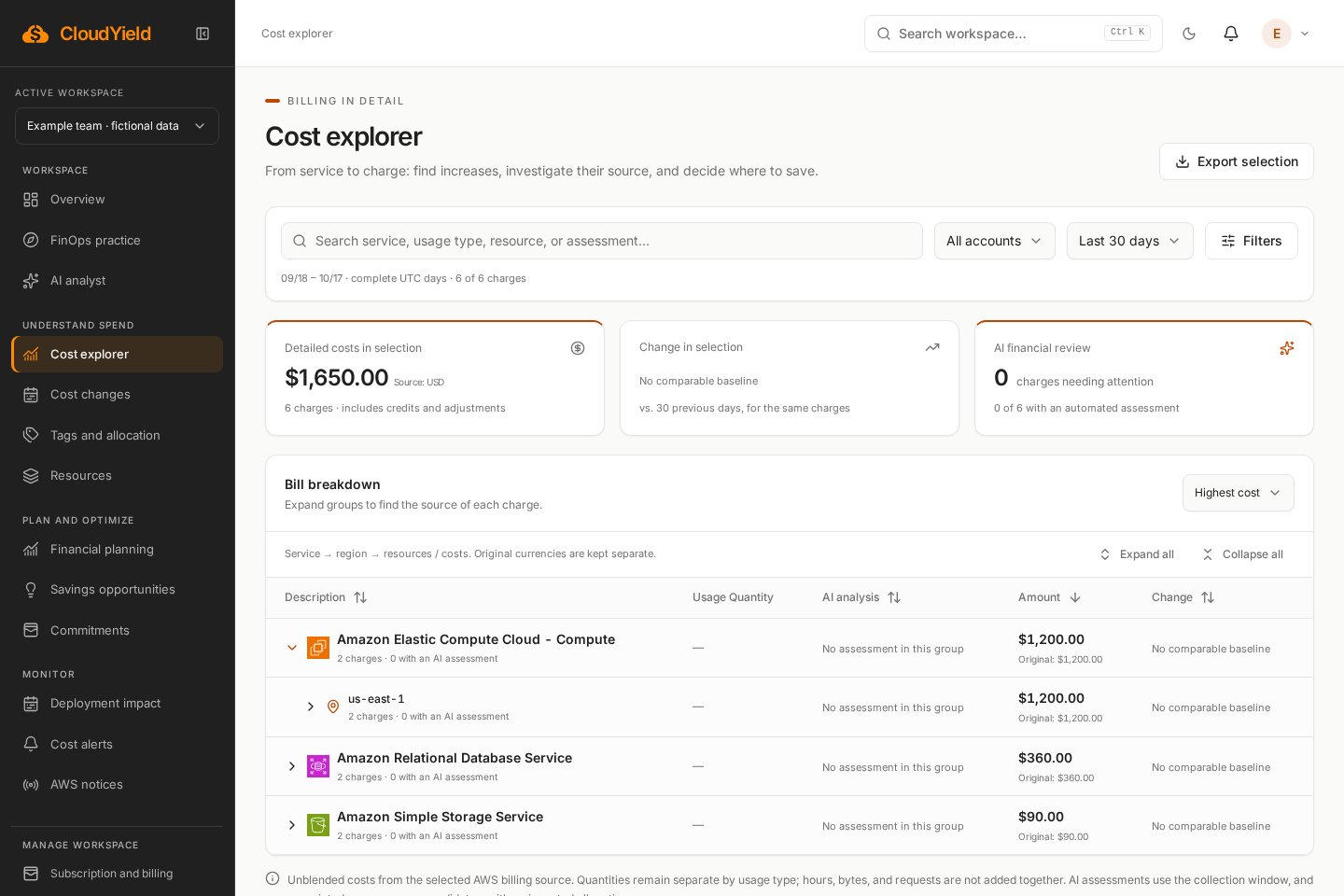
A cost report is more useful when someone knows what to do with it. Ownership connects a charge to a team that can explain the workload and assess the next step.
Agree on a small vocabulary
Treat tags as key/value pairs. team=platform communicates something different from environment=production. The Name tag may help identify a resource, but it is not a complete allocation strategy.
Choose keys your team can maintain. Document the intended meaning and allowed values so that similar workloads are not divided between inconsistent labels.
team=platform
environment=production
product=customer-portal
These are examples of a vocabulary, not evidence about any particular AWS account.
Keep inventory and billing evidence distinct
A tag visible on a resource does not automatically prove that every relevant charge is allocated to that tag in the available billing data. Check which tags and charges the billing evidence actually supports.
Keep service, region, period and currency attached to the result. When attribution is incomplete, preserve an explicit unallocated category instead of guessing an owner.
Make shared costs a team decision
Some charges support multiple products. Agree on an allocation rule and record why it is appropriate. If the rule is an internal estimate, label it as such; do not present it as direct resource-level billing attribution.
Review that rule when the workload changes. A split that once reflected usage may become misleading as products grow at different rates.
Turn the report into a review
Ask each owner to explain unexpected movements and identify missing information. Keep the resulting questions with the relevant period and charge so they can be revisited.
Better allocation is not, on its own, a cost reduction. Potential savings remain to be quantified without a specific action, attributable baseline, estimated post-change cost and evaluation period. If a proposal emerges, record its currency, sources and assumptions. Calculate baseline cost minus expected post-change cost minus additional costs, and check for overlap with other proposals.
Explore cost allocation in CloudYield, then use the AWS investigation guide to structure a review.